 Specialized in body contouring
 Specialized in body contouring
Surgical
Language
Official Accounts




Small, discreet scars
Implant placement tailored to your anatomy
Measures to reduce the risks of rupture and capsular contracture
For silicone breast implant placement, the incision is usually made in one of two locations:

At either incision site, we use a Keller Funnel, a breast implant delivery device, to minimize direct handling of the implant and help place it through the smallest practical incision.
The incision is then meticulously closed using plastic and reconstructive surgery techniques, so the scar can heal as discreetly as possible.
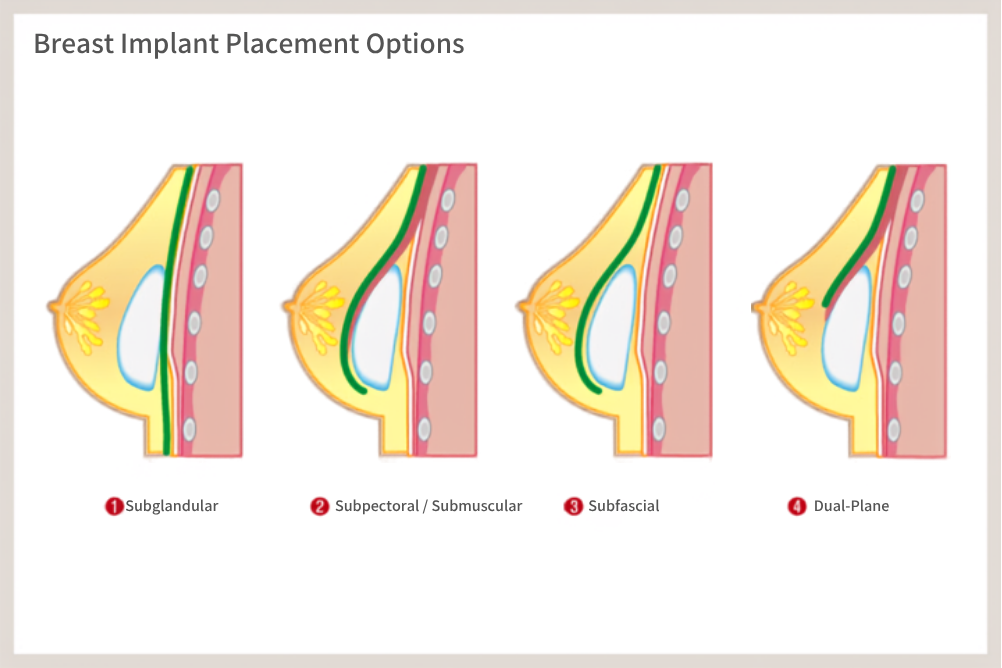
Breast implants can be placed in one of three anatomical planes:
1. Subglandular: behind the breast tissue and above the pectoral muscle
2. Subpectoral/submuscular: beneath the pectoralis major muscle
3. Subfascial: beneath the pectoral fascia
At MYCLI, we most often choose either subglandular or submuscular placement, based on the patient’s tissue thickness, skin quality, and desired shape.
・Relatively firm or less stretchable breast skin
・Enough subcutaneous fat and breast tissue to cover the implant
・Soft, pliable breast skin
・Limited subcutaneous fat or breast tissue
For patients who are not ideal candidates for standard subglandular placement, a hybrid approach may be considered. This combines subglandular implant placement with fat transfer to soften the implant edges and create a more natural contour.
In selected submuscular cases, we may use a dual-plane technique. By releasing part of the lower pectoralis major muscle, the implant is less likely to shift out of position and, when appropriate, a larger implant can be accommodated.
Our planning is informed by our surgeons’ experience in breast reconstruction, where breast shape is rebuilt from the ground up. This helps us tailor the approach to a wide range of anatomies and aesthetic goals.
Minor damage to the implant shell during insertion or excessive surgical handling can increase the risk of rupture over time.
To reduce this risk, we use a Keller Funnel, which helps minimize direct handling and friction during implant insertion.
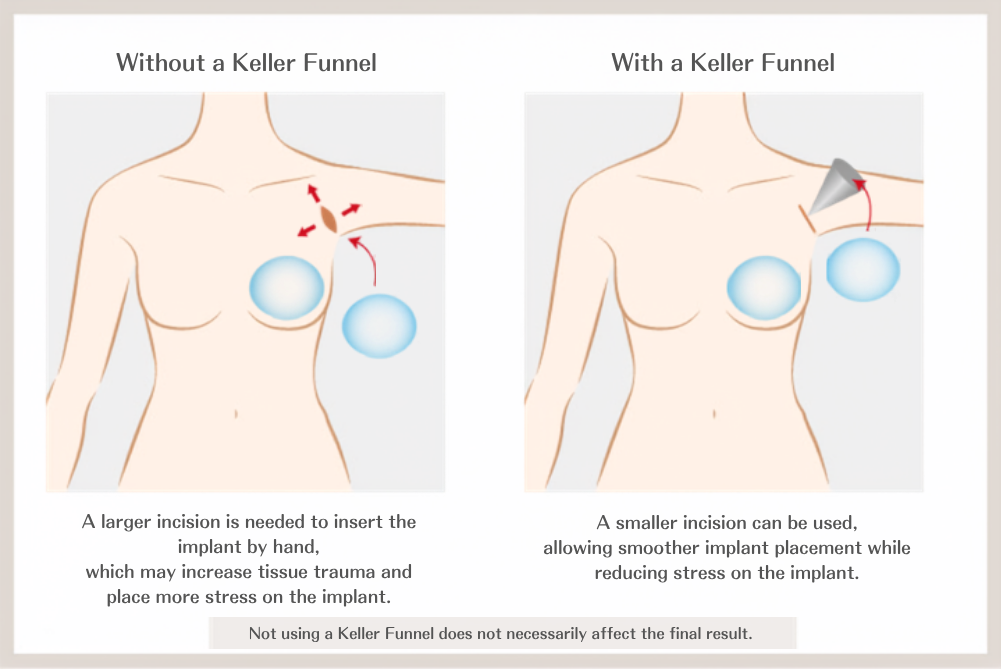
Capsular contracture risk can be influenced by implant surface characteristics, surgical technique, bleeding, infection, and each patient’s healing response.
At MYCLI, we use carefully selected Motiva implants, whose SmoothSilk surface—a low-roughness, nanotextured (4-micron) surface in a distinct category from older textured implants—is associated with a lower risk of capsular contracture. During consultation, we explain both the benefits and the limitations, as no implant removes the risk completely.

01Consultation
02Surgery scheduling and preoperative tests
03Surgery
04Recovery Room Monitoring and Compression Dressing
05Return home
06Suture removal, usually about one week after surgery
Initial downtime is typically about 3 to 7 days.
You may feel tightness in the breasts and mild to moderate discomfort when raising your arms or getting up.
When appropriate, we may use a long-acting local anesthetic to make the early recovery period more comfortable.
Sutures are usually removed about one week after surgery.
The implants we use do not require routine massage. We provide individualized postoperative instructions as needed.
QCan breast implants rupture?
Implant rupture can occur for several reasons. One recognized factor is tiny damage to the implant shell
during insertion or handling.
We use a Keller Funnel to reduce direct handling of the implant and help minimize this risk.
QWill I need to replace my implants?
Breast implants are medical devices and are not considered lifetime devices; they can gradually age over time.
However, routine replacement is not always necessary solely because a set number of years has passed, as long as there are no symptoms, imaging concerns, or other issues. Regular follow-up is recommended.
QWill the scar be noticeable?
We place the incision along a natural crease and in a position that is not visible from the front whenever possible, then close it carefully so the scar heals as discreetly as possible.
QIs the procedure painful?
The level of discomfort depends on the implant placement, but postoperative pain is usually well controlled with oral pain medication.
QCan I breastfeed after breast augmentation?
Our implant placement is designed to avoid disrupting the breast gland itself. Most patients are able to breastfeed after augmentation, although breastfeeding ability can vary depending on anatomy and the surgical approach.
Silicone Implant Breast Augmentation
Monitor Price −
Standard Price $8,953~
Hybrid Breast Augmentation (Silicone Implant + Fat Transfer)
Monitor Price −
Standard Price $13,428~
* Fees may vary depending on the scheduled date and the duration of the procedure.
* All prices include tax.
A clinic specializing in liposuction, breast augmentation, and aging care
T.I.B Ebisu 2F, 1-10-7 Ebisu, Shibuya-ku, Tokyo 150-0013
03-6450-2056(10:00-19:00)
1-minute walk from JR Ebisu Station
1-minute walk from Tokyo Metro Hibiya Line, Ebisu Station
Takemura Building 4F, 4-6 Chayamachi, Kita-ku, Osaka 530-0013
06-6676-8915(10:00-19:00)
1-minute walk from Hankyu Osaka-Umeda Station
About a 5-minute walk from Umeda Station, Midosuji Subway Line
About a 10-minute walk from JR Osaka Station and Hanshin Osaka-Umeda Station
Replies may take some time. Thank you for your understanding.